Advancing science through Quantum Sensing.
At CQTA, we built and connect quantum clocks to test fundamental physics.
Our research.
Are the fundamental constants of nature truly constant? Our TIQTOC (Trapped Ion Quantum Tests of Fundamental Constants) experiment uses ultraprecise highly-charged ion (HCI) clocks to find out. We can probe the stability of fundamental constants such as the fine structure constant, which governs electromagnetic interactions. Our approach compares clocks with different sensitivities to these constants. Any drift could reveal physics beyond the Standard Model, potentially signaling interactions with ultralight dark matter. To achieve this, we're involved in developing a robust, noise-free fiber network capable of connecting quantum clocks with extremely high precision.
The group also studies how the location of clocks (on the Earth's surface or on spacecrafts or satellites) and the data analysis technique should be optimized to maximise the likelihood of finding physics beyond the Standard Model.
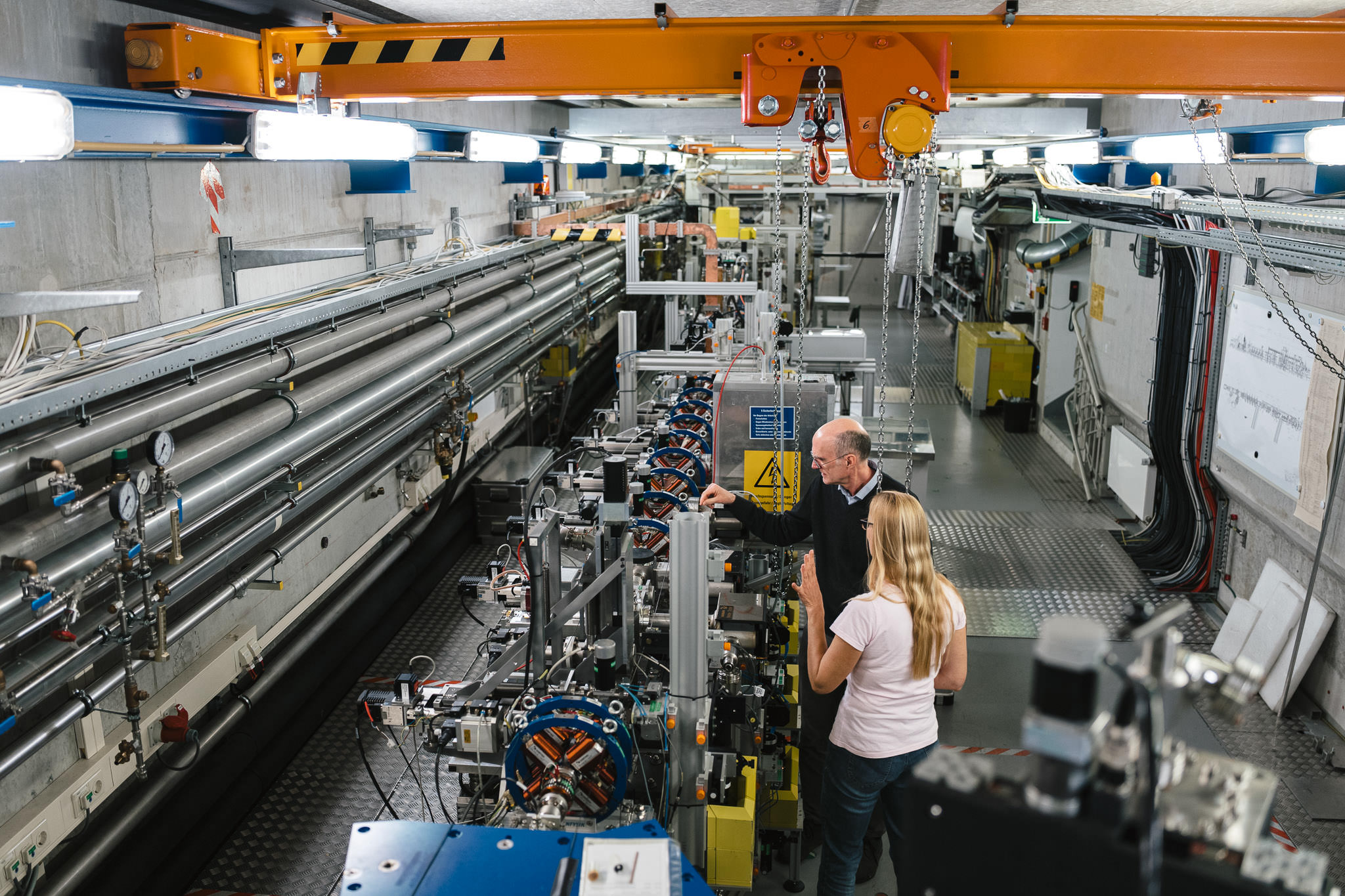
Quantum Sensors.
Quantum sensors are devices that exploit the features of quantum mechanics (e.g. interference, entanglement) to perform measurements that exceed the capabilities of classical detectors. The used quantum systems (e.g. photons, spins, atoms, ions, molecules, Bose-Einstein condensates) and the methods for state manipulation (e.g. lasers, electromagnetic waves) vary widely, and there are intimate connections to fields like quantum computing or metrology.
The team.
A team of physicists with diverse backgrounds working at DESY Zeuthen, at the Humboldt University in Berlin and at Max-Planck-Institut für Kernphysik is building quantum devices to search for new physics, pushing the boundaries of what we can detect and discover.
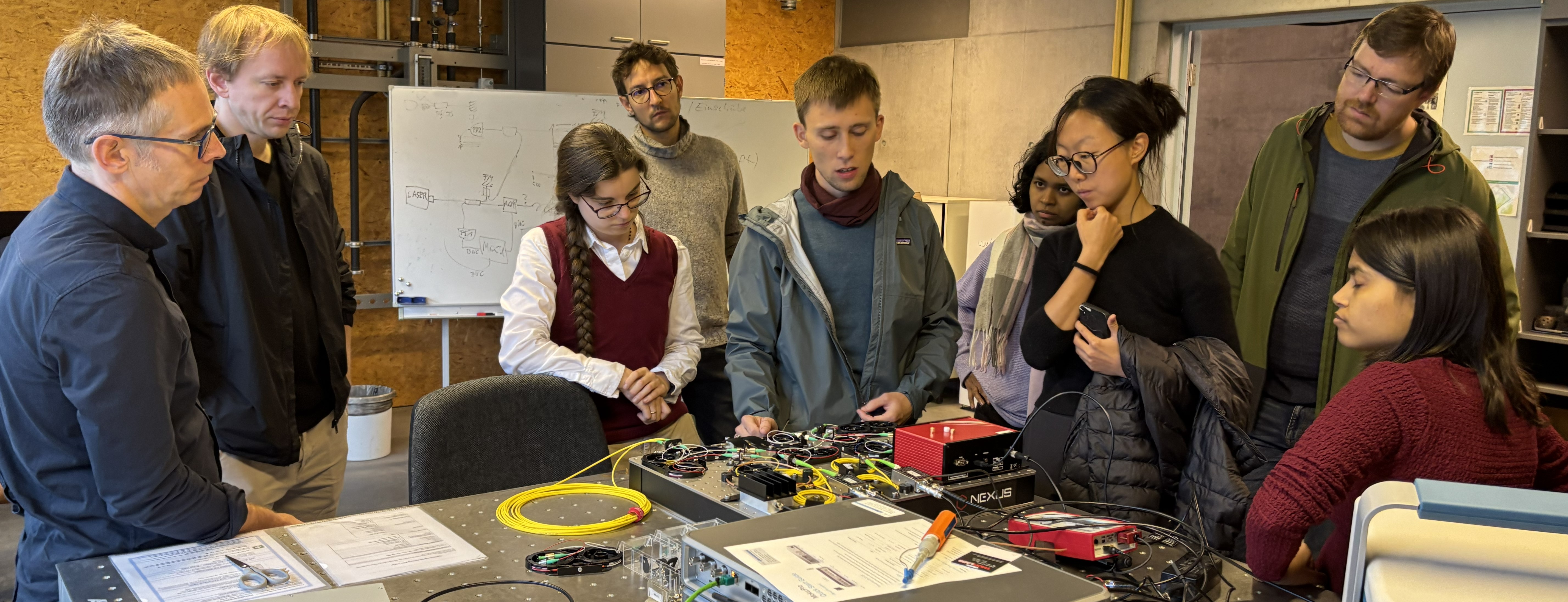
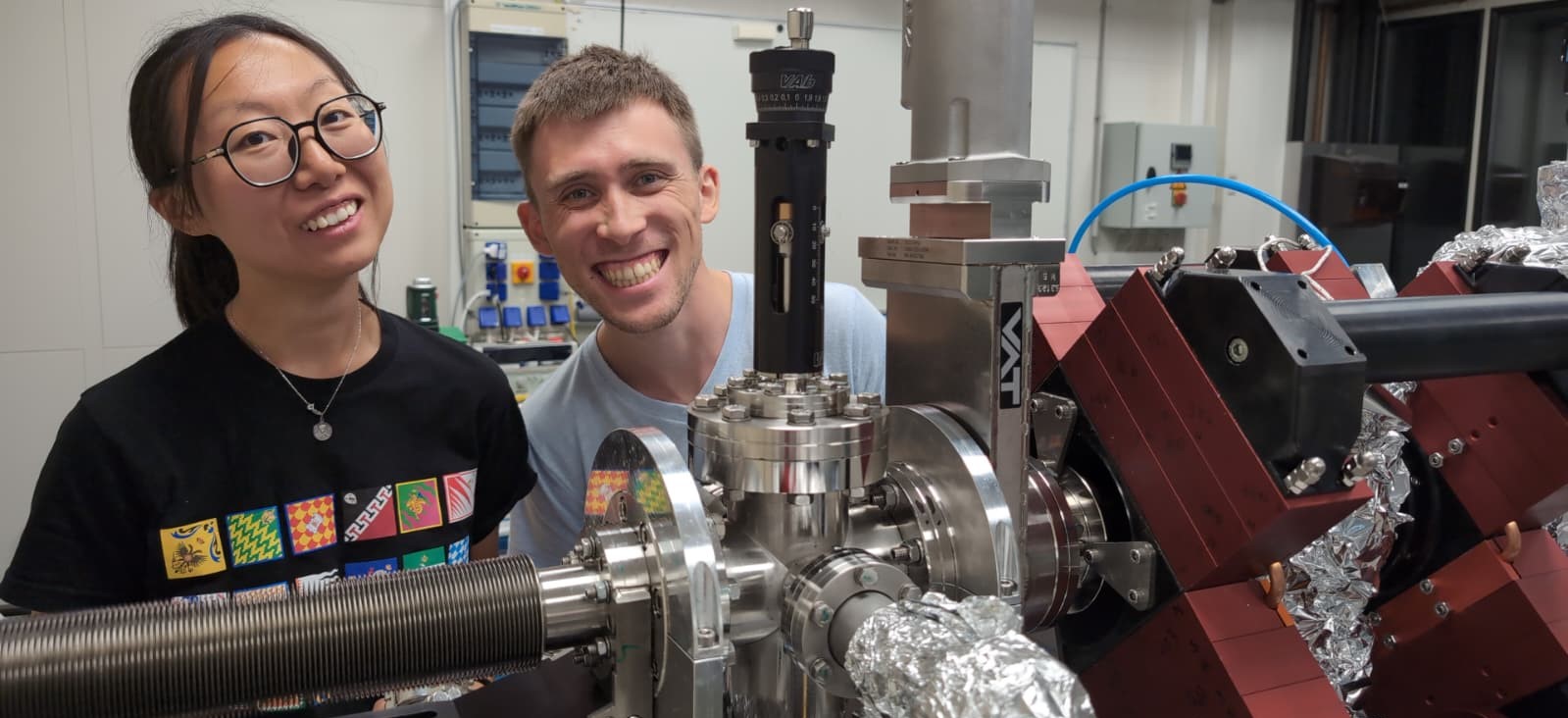
Are fundamental constants of nature changing over time, and how can we measure that accurately?
Together with our national and international collaborators, we are building a (dark) fibre network (QSNET) to compare clocks and detect if fundamental constants of nature are actually changing over time.
People and Contact.
StaffSteven Worm (group leader)
Cigdem
Issever (head of particle physics)
Ullrich
Schwanke (senior scientist)
Yang Yang
Christian Warnecke
Filipe Grilo
Elwin Dijck
Lakshmi Kozhiparambil
Luis Hellmich
Jonas Kankel
Nutan Kumari Sah
We offer bachelor's and master's theses in connection with clock projects.
We are always open for new collaborations and discussions.
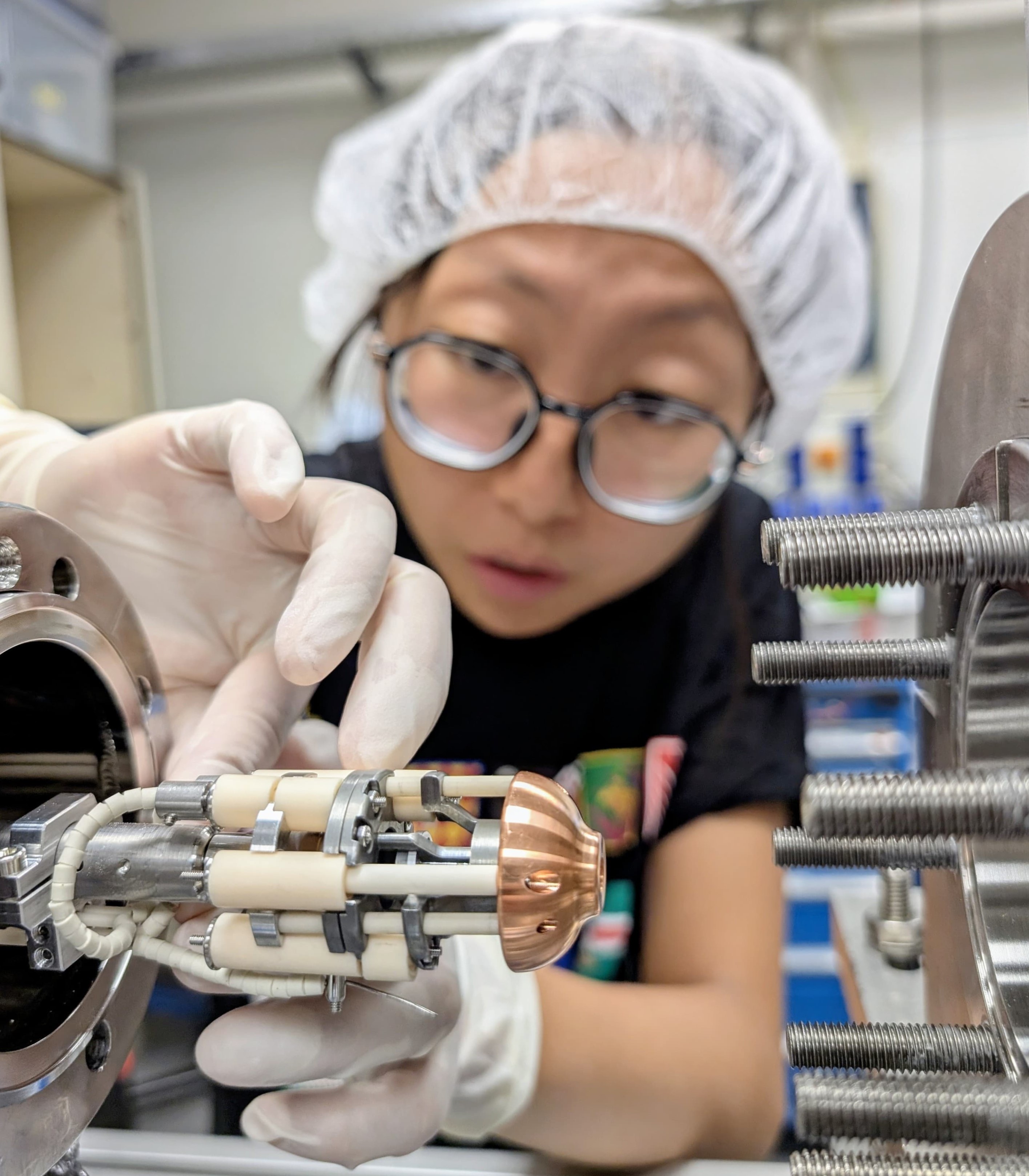
What we do at CQTA's TIQTOC experiment.
Time measurements, lasers, particle traps and the question of what holds the world together at its core.
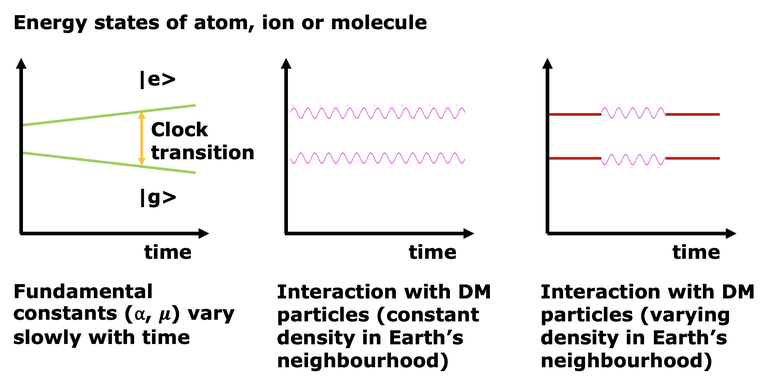
There are many ways to look for physics beyond the Standard Model using atoms and molecules. (See this review for more information.) One promising approach is the use of modern clocks that are based on atoms (atomic clock), ions or molecules. They allow very high precision measurements of time by stabilizing a laser at transition energies in the respective systems. However, these energy transitions depend on the features and constants of the so-far best tested and most accurate model of the fundamental interactions of nature: the Standard Model of particle physics.
The clock frequency is defined by an electronic transition (clock transition) between a ground state (labelled g in the leftmost plot) and an excited state e in the atom, ion or molecule. Transition energies (and hence the rate at which a given clock ticks) are sensitive to time variations of fundamental constants like the fine-structure constant α or the electron-to-proton mass ratio μ. As illustrated in the left plot, a variation of such constants might show up as a drift of the clock frequency. An interaction of the clock particles with dark matter particles might induce an oscillatory behaviour of the clock frequency (center plot); the oscillation frequency is determined by the mass of the dark matter particles. There could also be transient phenomena (right plot) when the Earth e.g. encounters a varying dark matter density on its orbit around the Sun.
Clock Comparisons and Networks.
In general, a time-dependent change of the clock frequency can only be detected in a comparison with other clocks. Such comparisons exploit the fact that the different clock types respond differently to a change of α or μ. Molecular clocks (e.g. N2+) are based on vibrational modes and are hence sensitive to μ only while atomic and ion clocks also have a dependence on α.
It is a common approach to connect clocks by dedicated glass fibre cables as planned for up to seven clocks in the QSNET project.
Highly-Charged Ion Clocks.
High-precision clocks are based on vibrational modes of molecules (molecular clock) or electronic transitions in atoms or ions (atomic or ion clock). So-called highly charged ion clocks (HCI clocks) are predicted to be very sensitive instruments in searches for ultra-light dark matter particles since the outer electrons are closer to the nucleus and strongly impacted by relativistic corrections.
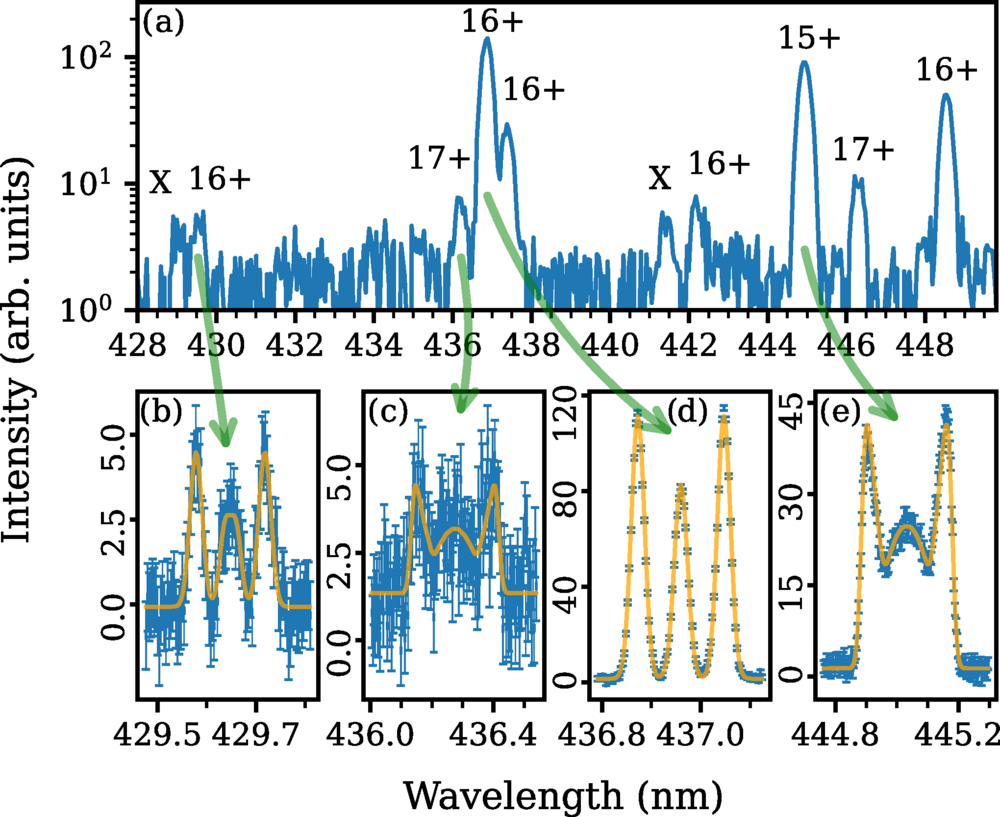
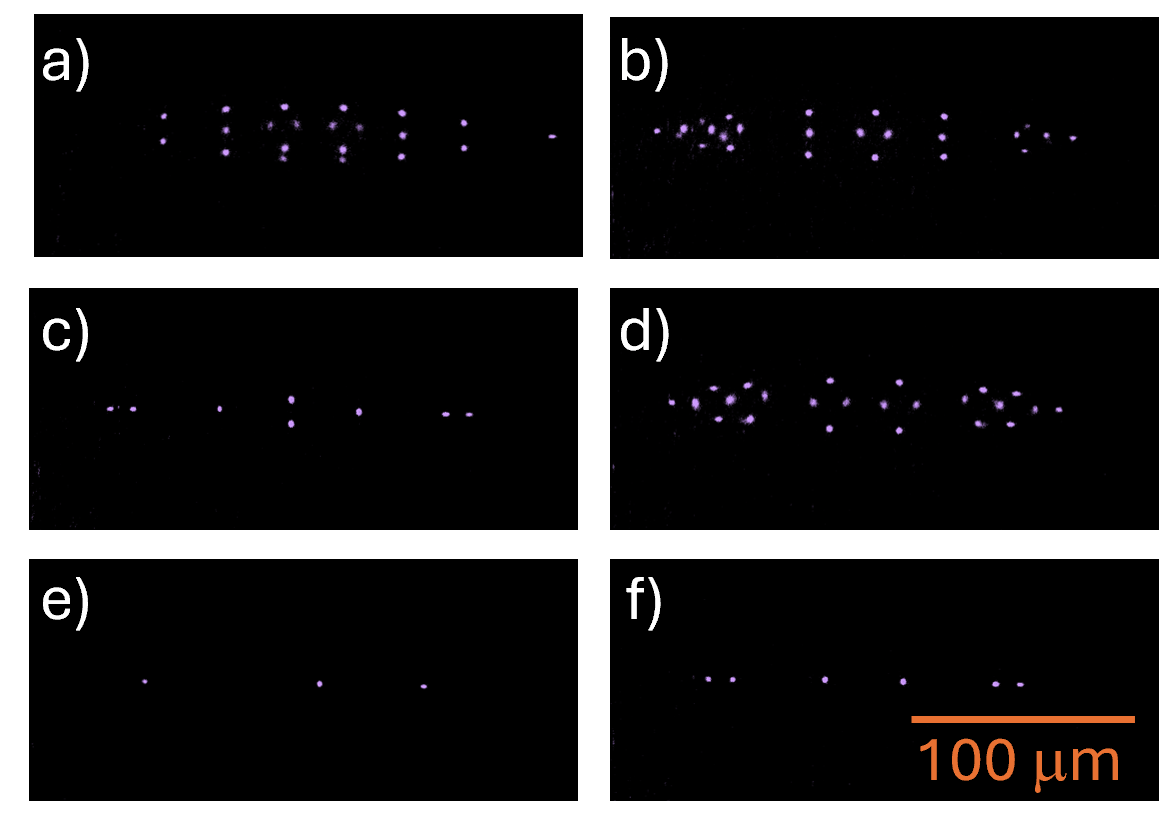
Our TIQTOC experiment at CQTA conducts research on HCI clocks based in the element Californium. A Californium clock is one of up to seven clocks in the planned QSNET clock network.
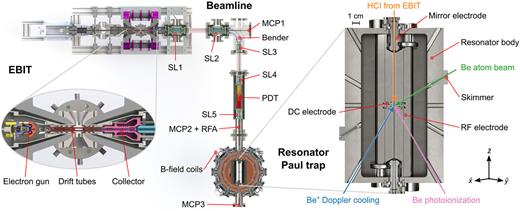
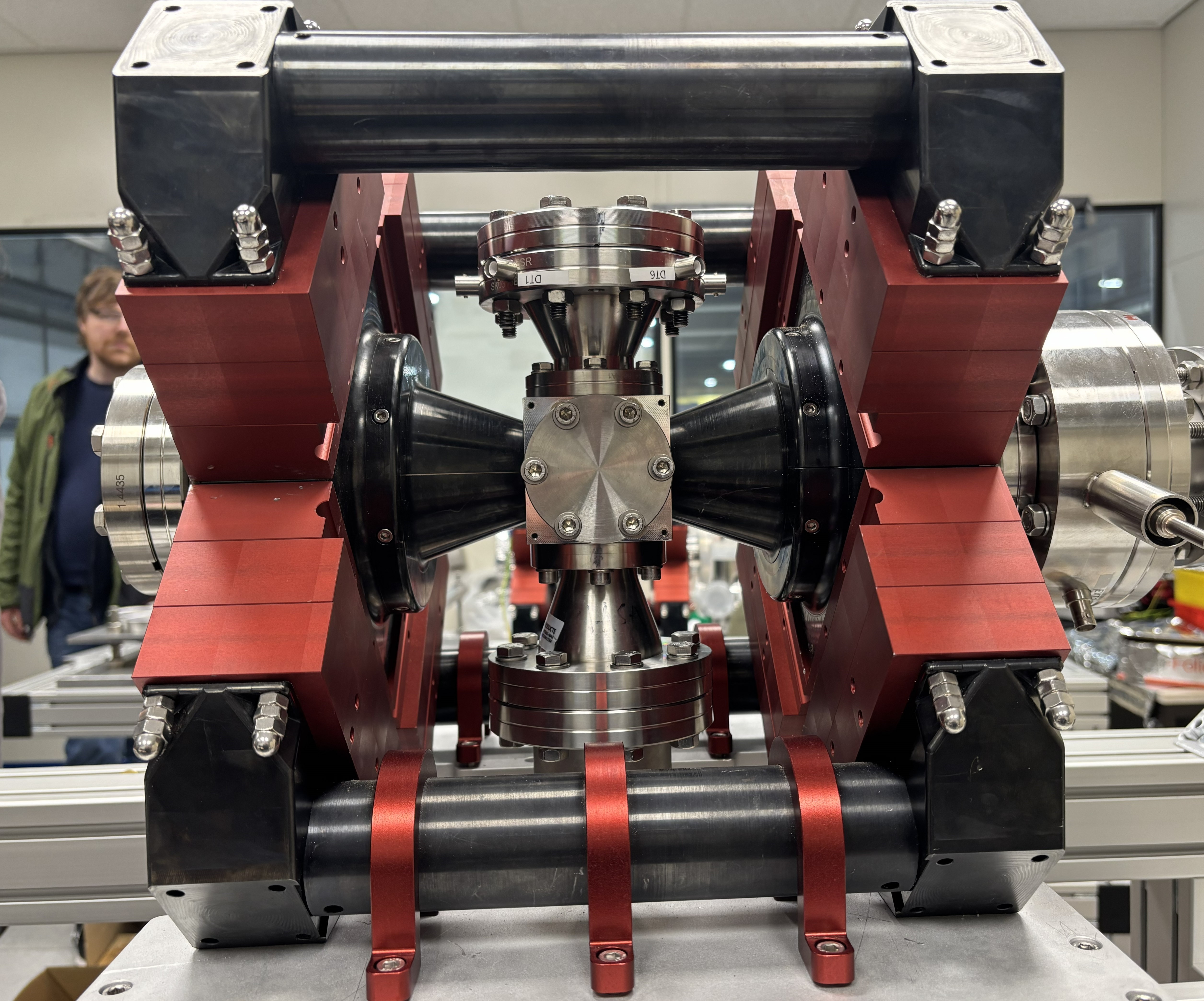
An HCI clock consists typically of a source for the generation of ions (e.g. an EBIT (electron beam trap)), a beam line for the selection of the right charge state, a particle trap for storage of the ions, and lasers for the cooling and manipulation of the stored ions. The image shows our EBIT.
The QSNET Project.
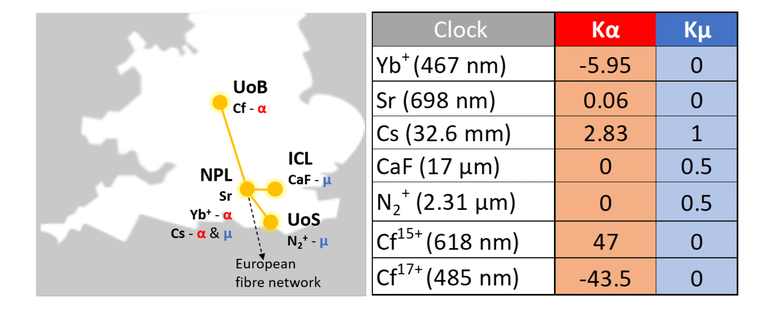
The QSNET in the UK, including the University of Birmingham (UoB), the National Physical Laboratory (NPL), the Imperial College London (ICL) and the University of Sussex (UoS).
The QSNET project is a future network of up to seven clocks located in the southern UK (cf. table below). The clocks employ atoms, ions and molecules; between 100 and 106 particles are kept in traps and define the clock frequency with the help of a suitable electronic transition. The clock frequency is transferred to a laser and the encoded information can be sent to a different site with the help of dedicated glass fibre cables. In this way, frequency ratios of various clock pairs can be measured as a function of time with a rate of about 1 Hz.
Any variation of the frequency ratio can be an indication for a variation of fundamental constants like the fine-structure constant α and the electron-to-proton mass ratio μ. Different clocks are expected to respond differently to a variation of α and μ. The table above lists the so-called sensitivity coefficients Kα and Kμ for the various clocks. A ten times bigger Kα implies a ten times better sensitivity to find an α variation. When combining two clocks the overall sensitivity is proportional to the difference of the Kα factors of the clocks (and similarly for Kμ).
The local group is involved in the construction of the Californium-ion clocks (Cf15+ and Cf17+), the exploration of suitable data analysis methods and the physics reach of the project. More information can be found in the QSNET White Paper from which also the plot above was taken.
Particle traps, lasers and frequency combs.
High-precision clocks based on atoms, ions (more) or molecules are sensitive devices in searches for ultra-light dark matter particles. The most advanced clocks store 100 to 106 particles in suitable traps. Modern laser technology is used to cool and interrogate the particles. For the actual operation as a clock, lasers are locked to the frequency of long-lived electronic transitions (clock transitions). The laser frequency is then measured with the help of frequency combs.
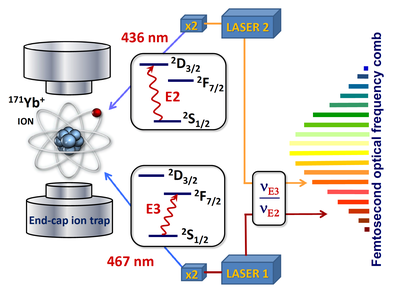
The above plot (taken from this review paper) illustrates the measurement principle for the case of a single Ytterbium ion (171Yb+). The ion is kept in an ion trap and cooled to minimize effects like Doppler broadening. Two lasers at 436 nm and 467 nm are locked to two different electronic transitions (an electric quadrupol (E2) and an electric octopol (E3) transition). The two transition frequencies are measured as a function of time by a femtosecond optical frequency comb. Any time dependence of the ratio of the two frequencies could be an indication for a time dependence of fundamental constants or an interaction with dark matter.
In the case of the Ytterbium ion, the frequency comparison takes advantage of two transitions in the same ion. Conceptionally, one of the transitions could be one in a different type of clock located far away. A frequency comparison is then still possible when the laser signal of the remote clock is transferred to the local frequency comb with the help of e.g. glass fibre cables. One such clock network is planned within the QSNET project.
Sensitivity Studies and Data Analysis.
The Standard Model of particle physics successfully describes the visible universe, but it must be extended to account for dark matter, the mysterious substance that makes up approximately 85% of the matter in the cosmos. One particularly intriguing possibility is ultra-light dark matter, with particle masses ranging between 10-22 eV/c2 and 10-10 eV/c2. These elusive particles could interact with fundamental constants of nature, causing tiny oscillations detectable only by the most precise measurement devices available: quantum clocks. The phenomenology of such interactions is remarkably rich (more), offering multiple pathways to discovery. At CQTA, we investigate which dark matter couplings our clock experiments can detect or constrain, develop optimal data analysis techniques to extract the faintest signals from noise, and explore how networks of synchronized clocks can enhance sensitivity to these cosmic whispers that may reveal physics beyond the Standard Model.
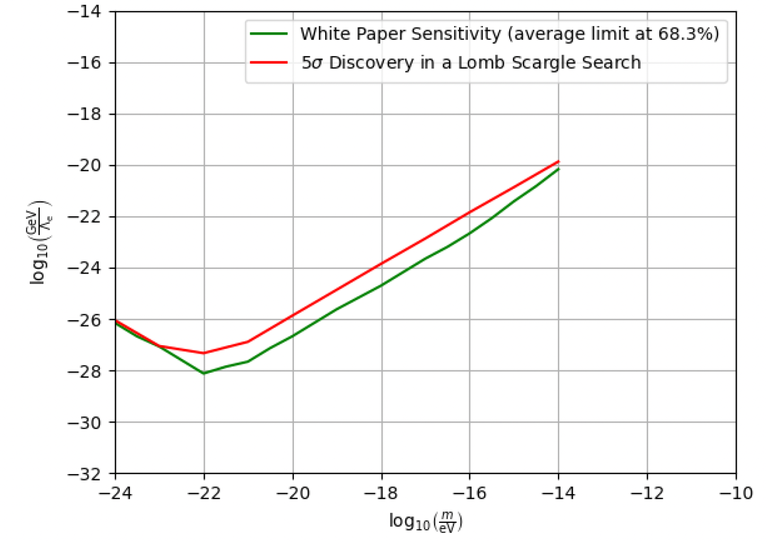
The plot above shows the result of a simulation study where Californium clocks were used to constrain the coupling of a hypothetical scalar dark-matter field to the electromagnetic field. It was assumed that the dark-matter field φ accounts for 100% of the local dark-matter density (0.4 GeV/cm3) and that its coupling to the electromagnetic field is linear in φ. The red curve shows the smallest coupling that can be detected at the 5σ level (local significance) in a search that uses 1 year of QSNET data and the Lomb-Scargle periodogram for data analysis. The green curve was taken from the QSNET White Paper and gives the average expected limit.