
Advancing science through
quantum computing and
quantum sensing.
Our work bridges quantum technologies with applications to both real-world challenges and fundamental science, aiming to unlock the computational advantages of quantum algorithms and enable ultra-precise sensing technologies.
We contribute to the next generation of quantum technologies by combining fundamental insights with practical relevance.
Quantum Computing.
What can quantum computing solve?
We develop quantum and quantum-inspired algorithms that address challenges ranging from fundamental physics to practical applications. Our research ranges from simulating particle interactions and quantum field theories to exploring general quantum physics for material science and quantum chemistry.
Beyond fundamental physics, we address real-world optimization and machine learning problems with quantum computers. As an IBM Quantum Innovation Center, we test our algorithms on cutting-edge quantum hardware, turning ideas into implementations. We're developing techniques that generally improve quantum algorithms, from error mitigation to circuit optimization. Our team brings together theoretical physicists, mathematicians, and computer scientists, creating a collaborative and highly productive environment.
Quantum Sensing.
Are the fundamental constants of nature truly constant?
Our TIQTOC (Trapped Ion Quantum Tests of Fundamental Constants) experiment uses ultraprecise quantum clocks to find out. By trapping ions like Californium 17+ and measuring their frequencies with extraordinary accuracy, we can probe the stability of fundamental constants such as the fine structure constant, which governs electromagnetic interactions.
Our approach compares clocks with different sensitivities to these constants. Any drift could reveal new physics, potentially signaling interactions with ultralight dark matter. To achieve this, we're involved in developing a robust, noise-free fiber network capable of connecting quantum clocks with unprecedented precision. This infrastructure not only enables our fundamental physics tests but also lays the groundwork for quantum information networks, where secure quantum communication will rely on exactly this kind of technology.
Key publications.
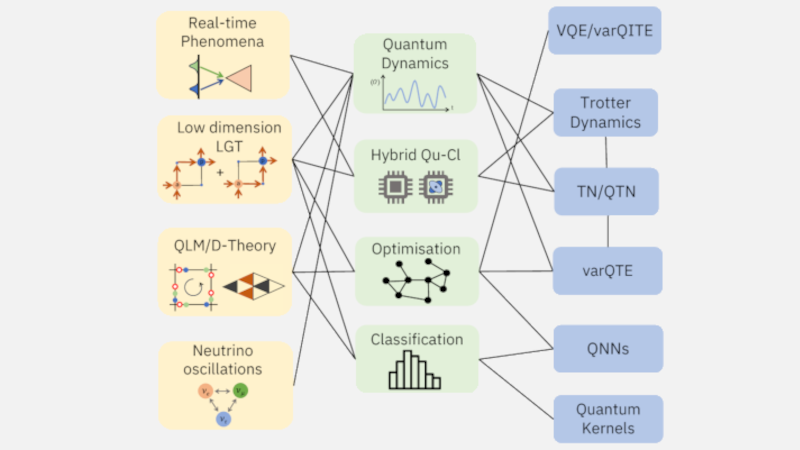
Quantum Computing for High-Energy Physics.
Quantum computers offer significant computational speedups for high-energy physics, from simulating theoretically challenging models to processing massive experimental datasets. This CERN-DESY-IBM roadmap presents near-term benchmark applications for ~100-qubit devices, aiming to demonstrate practical quantum advantage for the high-energy physics community.
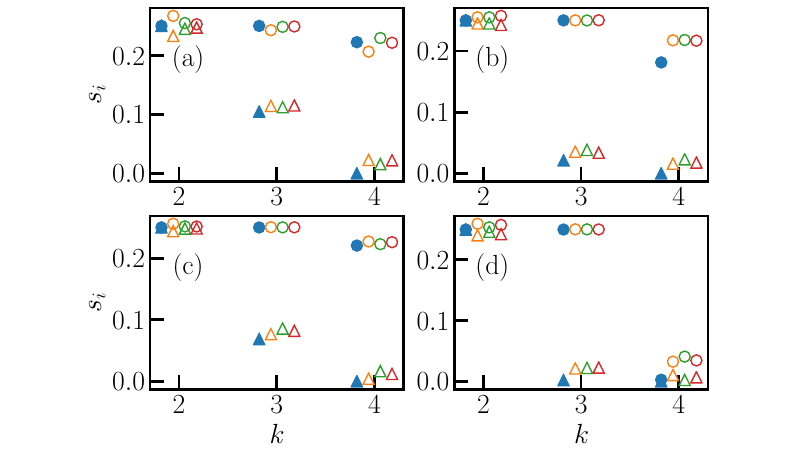
Dimensional Expressivity Analysis of Parametric Quantum Circuits.
We develop a method to analyze and optimize the expressivity of parametric quantum circuits by identifying redundant parameters and incorporating symmetries, enabling more efficient variational quantum algorithms with fewer parameters and demonstrated on IBM quantum hardware.
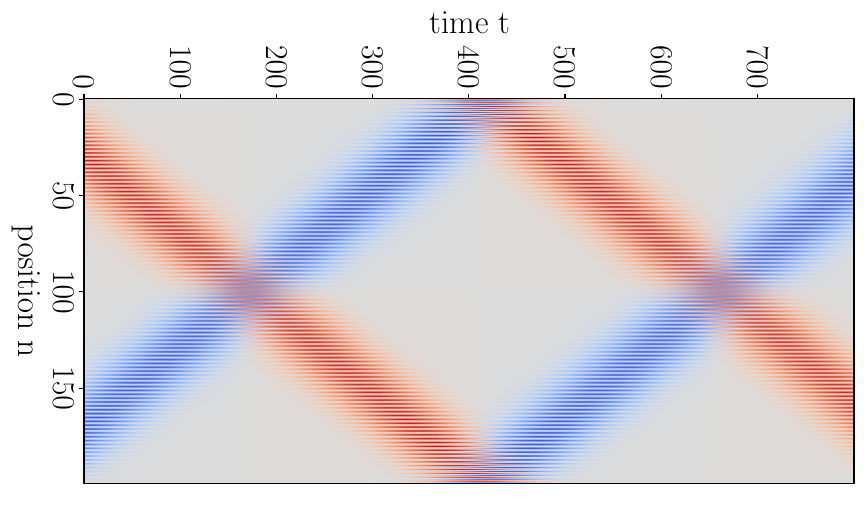
Fermionic wave packet scattering: a quantum computing approach.
We develop a method to prepare and evolve Gaussian wave packets on quantum computers for simulating scattering processes, demonstrated through Thirring model calculations and validated on IBM quantum hardware as a step toward studying particle collisions on near-term devices.
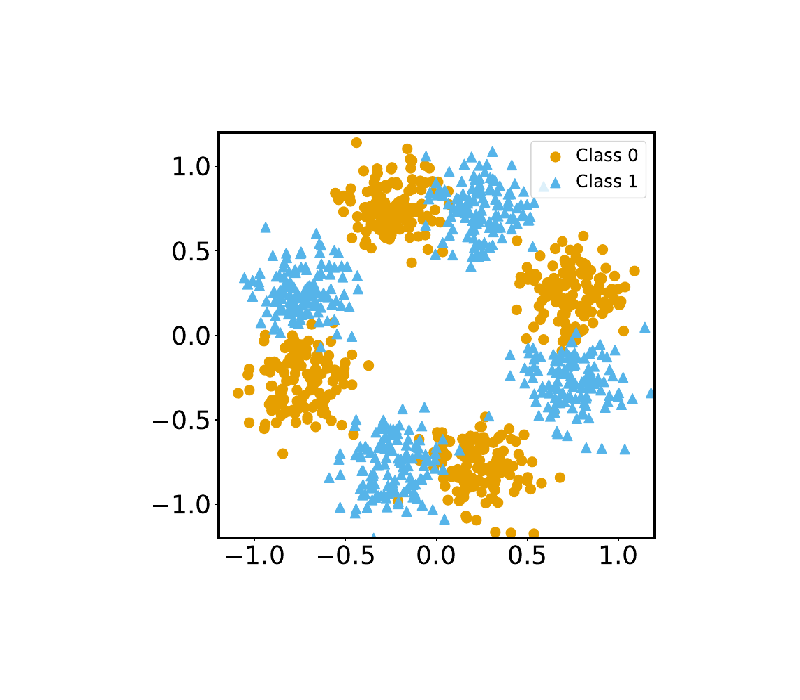
Symmetry Breaking in Geometric QML in the Presence of Noise.
We investigate how hardware noise affects equivariant quantum neural networks, showing that symmetry breaks linearly with noise strength and circuit depth under certain channels, and propose strategies to enhance symmetry protection, validated through simulations and experiments on up to 64 qubits.
Funding sources.